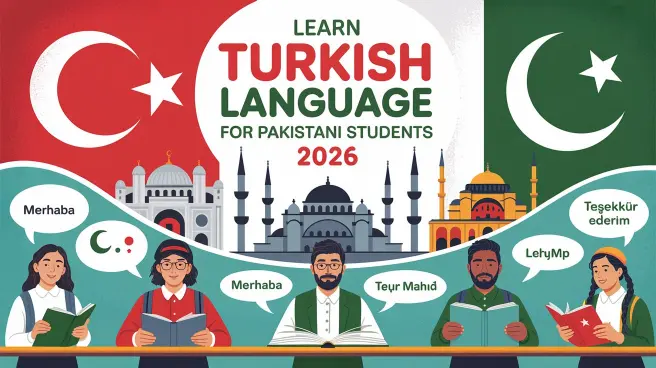
Learn Turkish Language for Pakistani Students 2026: The Complete Guide
INTRODUCTION
Turkey has rapidly become one of the most popular study destinations for Pakistani students — and for very good reasons. Over 208 universities, tuition fees starting as low as $500 per year, a Muslim-majority culture that feels familiar, and one of the world’s most generous government scholarships — the Türkiye Burslari — all make Turkey an outstanding choice.
But here is what many Pakistani students overlook until it is too late: to truly thrive in Turkey, you need to learn Turkish. Not just for university programs taught in Turkish, but for daily life, bureaucracy, social integration, and long-term career prospects in one of the most dynamic economies in the region.
This complete guide on how to learn Turkish language for Pakistani students 2026 covers everything — why Turkish matters, how difficult it is to learn, official proficiency levels and exams, the best free and paid resources, step-by-step preparation tips, and how Turkish language skills connect directly to your study abroad journey.
If you are planning to study in Turkey and need expert guidance on university selection, scholarships, or visa applications, the team at Endeavours International Consultants provides personalized counselling for Pakistani students at every stage.
Why Pakistani Students Should Learn Turkish in 2026
Learning Turkish is no longer just a nice-to-have for Pakistani students — in many cases, it is a genuine competitive advantage. Here is why:
1. Most Turkish University Programs Are Taught in Turkish While Turkey has over 1,300 English-taught master’s programs, the vast majority of undergraduate and many postgraduate programs are conducted entirely in Turkish. If your dream program is taught in Turkish, you have no choice but to reach B2 or C1 proficiency before admission or during your first preparatory year.
2. The Türkiye Burslari Scholarship Includes a Turkish Language Year Pakistan’s most pursued Turkish scholarship — the Türkiye Burslari (Turkish Government Scholarship) — includes a mandatory one-year Turkish language preparation course for all international students before they begin their university programs. This makes A1/A2 Turkish preparation before departure a significant head start.
3. Daily Life in Turkey Requires Basic Turkish English is not widely spoken outside major tourist areas and university campuses in Turkey. Shopping, transport, housing, medical appointments, and government offices all operate primarily in Turkish. Students who arrive with even basic Turkish (A1–A2) adapt far more quickly and comfortably.
4. Turkish Employers Strongly Prefer Turkish Speakers If you plan to work part-time during your studies or pursue a career in Turkey after graduation, Turkish proficiency is essentially non-negotiable. Pakistani students with strong Turkish skills (B2+) have a measurable advantage in the Turkish job market.
5. Turkish and Urdu Share Surprising Similarities Here is good news for Pakistani students: Turkish and Urdu share hundreds of loan words, primarily through Arabic and Persian roots. Words like kitap (book), mektup (letter), şeker (sugar/shakar), dükkân (shop/dukaan), and many more will feel immediately familiar. This linguistic overlap gives Pakistani learners a genuine head start compared to most other nationalities.
6. Turkish Opens Doors Beyond Turkey Turkish is spoken by over 80 million people in Turkey and by millions more in Turkish diaspora communities across Europe, Central Asia, and the Middle East. Turkish proficiency can open doors in Azerbaijan, Uzbekistan, Kazakhstan, and several other Turkic-speaking nations that share linguistic roots with Turkish.
To explore everything Turkey offers Pakistani students academically, visit the Endeavours study destinations page.
How Difficult Is Turkish for Pakistani Students?
Before diving into preparation strategies, it helps to understand what you are getting into.
The US Foreign Service Institute (FSI) classifies Turkish as a Category III language for English speakers — requiring approximately 1,100 class hours to reach professional working proficiency. For comparison, French and Spanish are Category I (600 hours), while Arabic and Chinese are Category IV (2,200+ hours).
So Turkish sits in the middle — genuinely challenging, but very achievable with the right approach.
What makes Turkish challenging:
- Agglutination: Turkish builds words and meaning by attaching multiple suffixes to a root word. A single Turkish word can express what takes an entire English sentence. For example, Çekoslovakyalılaştıramadıklarımızdanmışsınız is technically one word meaning “You are said to be one of those whom we could not make Czechoslovakian.”
- Vowel Harmony: Turkish vowels follow a harmonious pattern within words — back vowels stay with back vowels, and front vowels stay with front vowels. This affects which suffix form to use and must be internalized over time.
- Verb-Final Word Order: Turkish sentences typically end with the verb (Subject-Object-Verb), unlike English (Subject-Verb-Object). This requires a significant mental adjustment.
- No grammatical gender — a relief for Pakistani learners who know Urdu, which does use gender
What makes Turkish surprisingly accessible for Pakistani learners:
- Turkish is phonetically consistent — every letter is pronounced the same way every time, and spelling follows pronunciation
- Hundreds of shared vocabulary words with Urdu through Arabic and Persian roots
- No irregular plural forms in the way English or German has them
- The script is Latin alphabet (since 1928) — easy for Pakistani students already comfortable in English
For most dedicated Pakistani learners, reaching A2–B1 Turkish in 6–9 months of consistent study is very realistic.
Turkish Language Proficiency Levels: The CEFR Framework
Like most European languages, Turkish proficiency is measured using the Common European Framework of Reference for Languages (CEFR), which uses six levels:
| Level | Description | What You Can Do |
|---|---|---|
| A1 | Beginner | Introduce yourself, understand basic phrases, handle very simple interactions |
| A2 | Elementary | Handle routine interactions, understand simple texts, discuss familiar topics |
| B1 | Intermediate | Navigate most daily situations, understand straightforward texts and conversations |
| B2 | Upper Intermediate | Communicate fluently on a wide range of topics, understand complex texts |
| C1 | Advanced | Express yourself fluently and spontaneously for academic and professional purposes |
| C2 | Mastery | Near-native fluency, full comprehension of complex or implicit content |
For Pakistani students, here is what each level unlocks:
- A1–A2: Survival Turkish — daily life, shopping, transport, basic university campus navigation
- B1: Comfortable daily life in Turkey, better integration, some workplace communication
- B2: Admission to Turkish-taught university programs, stronger scholarship applications
- C1: Full academic Turkish — lectures, academic writing, research in Turkish
- C2: Teaching, professional translation, or native-level academic work
TÖMER: The Official Turkish Language Certification
The most widely recognized Turkish language certification for international students is the TÖMER certificate — named after the Türkçe Öğretim Merkezi (Turkish Language Teaching Centre), originally established by Ankara University.
TÖMER follows the CEFR framework from A1 to C2 and is recognized by:
- All Turkish universities for admission purposes
- Turkish employers
- Turkish immigration and residency authorities
- International institutions that recognize CEFR certifications
TÖMER courses are available:
- Inside Turkey: At university-affiliated TÖMER centers in Ankara, Istanbul, Izmir, Bursa, Antalya, Alanya, and other cities
- Online: Through the Yunus Emre Institute’s Distance Turkish Teaching Portal
For Pakistani students arriving in Turkey on the Türkiye Burslari scholarship, the mandatory first-year Turkish language course is typically conducted at a TÖMER center — making it your primary route to B1/B2 certification upon completion.
Yunus Emre Institute: Learn Turkish for Free Before You Leave Pakistan
One of the best-kept secrets for Pakistani students who want to learn Turkish language before arriving in Turkey is the Yunus Emre Institute (YEE).
The Yunus Emre Institute is Turkey’s official cultural and language promotion organization — the Turkish equivalent of Germany’s Goethe-Institut or the UK’s British Council. It operates cultural centers in over 60 countries and offers Turkish language courses — many free or very low-cost — to international learners.
Key Yunus Emre resources for Pakistani students:
Distance Turkish Teaching Portal (Online — Free) The YEE’s online Turkish learning platform at turkce.yee.org.tr is completely free and covers levels A1 through C1. It uses the Yedi İklim Türkçe textbook series — the same material used in formal TÖMER courses — with video lessons prepared by expert Turkish teachers. No registration fee required.
Turkish Proficiency Exam (TYS) The Yunus Emre Institute also administers the Turkish Proficiency Exam (TYS) — a formal certification exam held three times per year at Yunus Emre Institutes inside Turkey and at international partner locations. The TYS follows the CEFR framework, measures Reading, Listening, Writing, and Speaking, and is valid for university admissions in Turkey. For details and schedules: tys.yee.org.tr.
Online Group Courses Beyond self-study, the Yunus Emre Institute offers structured online group Turkish language courses. These courses have participants from all age groups worldwide, are conducted in a warm and culturally immersive environment, and serve as an excellent alternative for Pakistani students who do not yet have a local Turkish language institute near them.
If you are planning to study in Turkey and want to build Turkish foundations before departure, the Yunus Emre Institute online platform is the single best free resource available.
Turkish Language Exam Options for Pakistani Students
Pakistani students who want to certify their Turkish proficiency have several exam options:
1. TÖMER Certificate (Most Widely Accepted)
The standard certification for Turkish proficiency inside Turkey. Taken at TÖMER centers after completing course modules. Required or strongly preferred by most Turkish universities for Turkish-taught programs.
2. Turkish Proficiency Exam — TYS (International Recognition)
Administered by the Yunus Emre Institute three times per year. Valid for university admissions across Turkey. Increasingly accepted internationally. Conducted at Yunus Emre Institute locations globally. For full exam information, visit tys.yee.org.tr.
3. DİLMER (İstanbul University)
İstanbul University runs its own Turkish language certification program called DİLMER, which is widely respected and recognized by Turkish universities and employers. Available on campus in Istanbul.
4. University-Specific Turkish Exams
Some Turkish universities administer their own internal Turkish language proficiency tests as part of their admission process for Turkish-taught programs. These may be used alongside or instead of TÖMER certification.
Turkish Language Proficiency Required for Turkish University Admissions
Understanding exactly what Turkish level you need for your specific academic goal is essential before you begin your study plan:
| Academic Goal | Required Turkish Level |
|---|---|
| English-taught undergraduate program | No Turkish required (A1/A2 strongly recommended) |
| English-taught master’s program | No Turkish required (B1 recommended for daily life) |
| Turkish-taught undergraduate program | B2 – C1 (TÖMER or TYS certification) |
| Turkish-taught master’s program | C1 (TÖMER or TYS certification) |
| Türkiye Burslari Scholarship (all programs) | Preparatory year included; A1/A2 before arrival is a strong advantage |
| Post-study work in Turkey | B2 minimum for most professional roles |
| Turkish citizenship pathway | B1 minimum |
The Endeavours Universities page includes a wide range of Turkish universities — both English-medium and Turkish-medium — to help you match your language level with the right institution and program.
The Best Resources to Learn Turkish Language in 2026
You do not need to spend a fortune to build strong Turkish foundations. Here are the best resources for Pakistani students in 2026, from completely free to affordable paid options:
Free Resources
Yunus Emre Institute Distance Portal turkce.yee.org.tr — The gold standard for free Turkish learning. Covers A1–C1 with video lessons based on the official Yedi İklim Türkçe textbook series. Includes all four skills: Reading, Listening, Writing, Speaking. Completely free, no registration fee.
Duolingo Turkish Available on iOS and Android. Excellent for absolute beginners to build basic vocabulary and simple sentence patterns. Free with a premium option. Best used as a daily habit-builder alongside more structured resources — not sufficient alone for TÖMER exam preparation.
TurkishClass101 turkishclass101.com — Podcast-style lessons covering beginner to advanced levels. Free episodes available; premium unlocks full content. Particularly strong for Listening comprehension and conversational Turkish.
YouTube Channels
- Yunus Emre Institute YouTube Playlist — Official instructional videos aligned with Yedi İklim Türkçe textbooks
- Ali Yılmaz — Hundreds of videos explaining grammar concepts and vocabulary specifically designed for foreign learners
- Murat Hoca — TÖMER-style grammar explanations, useful for exam preparation
Paid Resources (Affordable)
Babbel Turkish More structured than Duolingo with actual grammar explanations. EUR 7–13/month depending on subscription plan. Good for building correct sentence structures at A1–B1 level.
Pimsleur Turkish Audio-based method, outstanding for developing natural pronunciation and conversational instincts. USD 15/month. Particularly valuable for Pakistani learners since Turkish pronunciation is phonetic and correct habits built early carry through to advanced levels.
Anki Flashcards (Free + Community Decks) apps.ankiweb.net — Free spaced repetition flashcard app. Download Turkish frequency list decks (top 1,000–3,000 most common Turkish words) and review them daily. This builds vocabulary faster than any other method.
Yedi İklim Türkçe Textbooks (Official TÖMER Series) The official textbook series used in TÖMER centers and Yunus Emre Institute courses. Available to purchase online. If you plan to eventually take the TÖMER certification exam, studying with these textbooks is essential since exam content aligns directly with the curriculum.
Step-by-Step Turkish Language Learning Plan for Pakistani Students
Here is a practical, realistic roadmap for Pakistani students targeting Turkish university study in 2026–2027:
Months 1–2: Foundation (A1 Level)
- Learn the Turkish Latin alphabet — it has 29 letters, 6 of which are unique to Turkish (ç, ğ, ı, ö, ş, ü)
- Master basic pronunciation — Turkish is phonetically consistent, so what you see is what you say
- Build a core vocabulary of 300–500 common words using Anki and Duolingo
- Begin the Yunus Emre Institute A1 online course
- Study essential grammar: present tense, personal pronouns, basic sentence structure, numbers, and greetings
Daily commitment: 45 minutes – 1 hour
Months 3–4: Elementary Communication (A2 Level)
- Expand vocabulary to 1,000–1,500 words
- Learn past and future tenses, question structures, negation
- Begin understanding simple conversations and short texts
- Start watching simple Turkish YouTube content — children’s educational channels or slow-paced vlogs — to build listening comprehension
- Practice writing short paragraphs about yourself and daily routines
Daily commitment: 1 hour
Months 5–8: Intermediate Survival (B1 Level)
- Reach 2,500–3,000 vocabulary words
- Master Turkish vowel harmony and agglutinative suffixes systematically
- Understand and discuss familiar topics — travel, food, education, current events
- Begin watching Turkish TV series with Turkish subtitles (not English subtitles)
- Practice writing emails, descriptions, and simple essays
- Attempt practice TYS or TÖMER B1 past papers
Daily commitment: 1–1.5 hours
Months 9–12: Academic Turkish (B2 Level)
- Vocabulary target: 4,000–5,000 words including academic and formal vocabulary
- Read Turkish newspaper articles and university-level texts
- Write structured academic paragraphs and short essays
- Engage in structured speaking practice — language exchange partners, online tutors, or conversation groups
- Complete TÖMER or TYS exam preparation with past papers and mock tests
Daily commitment: 1.5–2 hours
Turkish and the Türkiye Burslari Scholarship: What You Need to Know
The Türkiye Burslari (Turkish Government Scholarship) is the most prestigious — and comprehensive — scholarship available to Pakistani students seeking to study in Turkey. It covers full tuition, monthly living stipend, accommodation, health insurance, and return airfare.
One critical feature of the Türkiye Burslari is its mandatory Turkish language preparation year. All scholarship recipients who will study in Turkish-medium programs must complete a one-year intensive Turkish language course at a TÖMER center in Turkey before beginning their university program.
Why starting Turkish before you arrive matters:
- Students who arrive with A1/A2 Turkish advance through the preparatory year faster and perform at a higher level
- Some scholarship recipients use the preparatory year to reach B2 — sufficient for Turkish-taught programs — while others who started from zero may need extra time
- Strong Turkish from day one means better integration, more friendships, and a richer experience in Turkey
The Türkiye Burslari 2027 cycle is expected to open approximately in October 2026. If you begin learning Turkish now, you will have a meaningful foundation by the time applications open. For guidance on applying for Turkish scholarships, visit the Endeavours scholarship guidance page.
Learning Turkish Alongside Other Study Destinations
Turkey is an outstanding choice, but smart students always compare their options. Here is how Turkish language learning fits into a broader study abroad strategy:
If Germany appeals to you, you would need German (B2/C1 for German-taught programs). For the UK, IELTS is the key requirement. For Malaysia or Dubai, English-medium programs are the norm. Turkey is unique in that its scholarship includes language training, making it unusually accessible even for students with no prior Turkish experience.
Explore how Turkey compares to other study destinations that Endeavours supports Pakistani students with:
- Study in the UK — IELTS required, globally prestigious degrees
- Study in Australia — Strong employment pathways, English-medium
- Study in Canada — Immigration-friendly, world-class institutions
- Study in Germany — Tuition-free public universities, German required
- Study in Malaysia — Affordable, accessible, English-medium programs
- Study in Dubai — Close to home, strong business and media programs
- Study in Finland — Top-ranked education, many English-medium options
- Study in France — Prestigious institutions, affordable tuition
- Study in Cyprus — Affordable European education, English-medium programs
Browse the full range of courses available through Endeavours to compare programs and language requirements across all destinations.
Common Mistakes Pakistani Students Make When Learning Turkish
Starting too late: The Türkiye Burslari requires strong performance in the preparatory Turkish year. Students who arrive with zero Turkish background struggle far more. Start at least 6–9 months before your planned departure.
Relying only on Duolingo: Duolingo is a great starting habit but insufficient for TÖMER exam preparation or academic Turkish. Pair it with the Yunus Emre Institute’s structured curriculum and regular writing and speaking practice.
Ignoring Turkish grammar systematically: Turkish grammar — especially vowel harmony and agglutination — requires intentional study, not just passive exposure. Dedicate specific study sessions to grammar rather than relying only on vocabulary acquisition.
Skipping Speaking practice: Many students focus exclusively on Reading and vocabulary but neglect Speaking. Since both the TYS and TÖMER exams include Speaking components, and since daily life in Turkey requires oral communication, integrate Speaking practice from the very beginning.
Not using Turkish media: Turkish TV series (diziler) are enormously popular globally and are an outstanding listening comprehension resource. Shows like Diriliş: Ertuğrul — which Pakistani audiences already love — are ideal for immersive listening practice at intermediate levels.
Final Thoughts
The decision to learn Turkish language as a Pakistani student in 2026 is one of the smartest investments you can make in your academic and professional future. Turkish opens direct access to Turkey’s world-class universities, its generous government scholarships, and a fast-growing economy of 85 million people. With genuine linguistic advantages for Urdu speakers and an abundance of free, high-quality learning resources, there has never been a better time to start.
Begin with the Yunus Emre Institute’s free online platform, build consistent daily study habits, and aim for B1 Turkish before you depart for Turkey. Every hour you invest in Turkish before arrival translates directly into better academic performance, faster integration, and a richer life experience in one of the world’s most fascinating countries.
And when you are ready to take the next step — applying for Turkish universities, preparing your Türkiye Burslari scholarship application, or navigating the student visa process — Endeavours International Consultants is your trusted partner.
Contact Endeavours today for a free counselling session and a personalized study abroad roadmap that includes your Turkish language preparation timeline, university selection, and scholarship strategy.
Stay informed with the latest study abroad tips, language exam guides, and destination updates by visiting the Endeavours blog regularly. You can also download the Endeavours prospectus for a comprehensive overview of all available universities, courses, and destinations for Pakistani students in 2026.
Frequently Asked Questions (FAQs)
Q: Do I need Turkish to study in Turkey as a Pakistani student? Not always. Turkey has over 1,300 English-taught master’s programs. However, for Turkish-taught programs, you need B2–C1 Turkish. For the Türkiye Burslari scholarship, a preparatory Turkish language year is included. Even for English-taught programs, A1/A2 Turkish significantly improves your daily life and integration in Turkey.
Q: Is Turkish hard to learn for Pakistani students? Turkish is classified as a Category III language (1,100 hours to professional proficiency). However, Pakistani learners have an advantage — hundreds of shared vocabulary words with Urdu through Arabic and Persian roots make the early stages notably easier. With consistent effort, A2–B1 Turkish is achievable in 6–9 months.
Q: What is the TÖMER certificate and do I need it? TÖMER is the standard Turkish language certification for non-native speakers, recognized by Turkish universities, employers, and immigration authorities. It is required for admission to Turkish-taught university programs. For English-taught programs, it is not required but is an asset.
Q: What is the best free resource to learn Turkish online? The Yunus Emre Institute’s Distance Turkish Teaching Portal (turkce.yee.org.tr) is the best free resource. It covers A1–C1 using the official TÖMER curriculum, is completely free with no registration fee, and is accessible on any device.
Q: How long does it take to reach B2 Turkish? For a Pakistani student studying 1–1.5 hours daily, reaching B2 typically takes 9–14 months of consistent, structured study. Students who enroll in the Türkiye Burslari preparatory year and study intensively can reach B2 in approximately 8–10 months.
Q: Can I learn Turkish before going to Turkey? Absolutely. The Yunus Emre Institute’s online platform, TurkishClass101, Duolingo, Babbel, and YouTube channels all provide excellent pre-departure Turkish preparation. Many Pakistani students reach A2 or B1 level before arriving in Turkey, giving them a significant head start.
Q: What Turkish level is needed for the Türkiye Burslari scholarship? The scholarship includes a mandatory one-year Turkish language preparatory course for students enrolling in Turkish-medium programs. No prior Turkish is required to apply, but arriving with A1/A2 gives you a measurable advantage during the preparatory year.
For personalized study abroad guidance and Turkish language preparation support, visit endeavourspk.com or call +92 320 6565059. Offices in Faisalabad and Lahore